

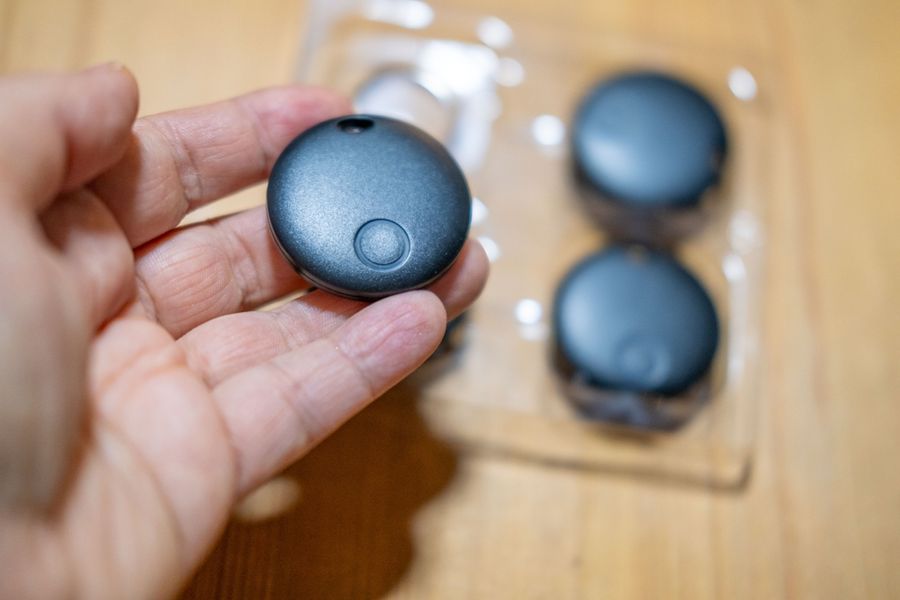
Misplacing keys at home is annoying; losing a bag during a trip can be far more disruptive. Small Bluetooth trackers give everyday items a digital trail, letting you ring something nearby or check its last or reported location through a compatible phone network. The best choice depends less on the shape of the tracker than on your phone, the item you want to protect, and whether features such as replaceable batteries, precise finding, or slim designs matter most.
Start With the Phone Ecosystem
Before comparing range or battery life, check which finding network your phone supports. Apple’s current AirTag works through Find My and can use Precision Finding with compatible iPhones or Apple Watches, showing distance and direction when the tracker is nearby. Farther away, nearby Apple devices can anonymously relay its location through the Find My network. AirTag also uses a replaceable CR2032 battery and carries an IP67 rating.
Galaxy SmartTag2 is designed for compatible Samsung Galaxy devices using SmartThings Find. It offers Search Nearby, an audible ring, and Compass View on supported Ultra Wideband Galaxy phones. Chipolo POP can pair with either Apple Find My or Google’s Find Hub on Android, although it uses only one network at a time. It also has a built-in key-ring hole and replaceable CR2032 battery.
Match the Tracker to Your Keys
Keys benefit from a tracker that is easy to attach and hear when it disappears under furniture, inside a jacket, or at the bottom of a bag. Chipolo POP attaches directly to a key ring and is rated at about 120 dB. Tile Pro is another key-friendly design; the 2024 model has a listed Bluetooth range of up to 500 feet, a replaceable one-year battery, and IP68 water resistance.
AirTag can be useful for iPhone owners who want directional finding nearby, but it does not include a key-ring hole, so keys generally require a separate holder. When choosing a key tracker, consider how securely it attaches and how useful its nearby-finding tools will be. Those details may matter more day to day than maximum advertised Bluetooth range.
Choose the Right Shape for Bags and Wallets
Backpacks, purses, laptop bags, and camera bags offer enough interior space for most tag-shaped trackers. Keeping one in a secure internal pocket can also reduce the chance that it snags or falls off. Wallets and passport holders are different: a thick round tracker may create an awkward bulge, making a card-shaped design more practical.
Tile Slim is designed to slide into wallets, passport holders, luggage, and similar items. The 2024 version is 2.5 millimeters thick and has a stated three-year battery life, but that battery is non-replaceable. A sealed design can stay thin, while trackers with replaceable coin cells can remain in service after the original battery is depleted.
Make Luggage Easier to Locate
A smart tracker can provide another source of information when checked luggage does not arrive where expected. Trackers connected to large finding networks can report a bag’s location when compatible participating devices pass nearby, even when the owner’s phone is elsewhere. They are not dedicated cellular GPS trackers, so remote location updates depend on the finding network and nearby devices.
AirTag also allows owners to temporarily share an item’s location through Find My, including with participating airlines. Apple says access can end when the item is recovered or expire automatically after seven days. For any luggage tracker, place it securely inside the suitcase rather than depending on an exposed loop or external strap that could detach during handling.
Pay Attention to Battery Life and Durability
Battery design affects how long you can keep using a tracker. AirTag, Chipolo POP, Tile Pro, and Galaxy SmartTag2 all use replaceable coin-cell batteries. Samsung lists up to 500 days for SmartTag2 under typical-use assumptions, while Chipolo rates POP for up to one year and Life360 lists a one-year replaceable battery for the 2024 Tile Pro.
Durability matters for items exposed to rain or spills. Current specifications list IP67 resistance for AirTag and Galaxy SmartTag2, IP55 for Chipolo POP, and IP68 for 2024 Tile models. Check the limitations behind those ratings rather than assuming a tracker is suitable for prolonged underwater use.
Pick a Tracker That Fits Your Routine
There is no single tracker that is ideal for every keychain, backpack, wallet, and suitcase. Start with your phone ecosystem, then consider the item’s size and how you are most likely to lose it. Directional finding can be valuable for keys, a slim profile makes more sense in a wallet, and network-based location reporting becomes useful when luggage travels beyond your immediate Bluetooth range.
Set up the tracker before you need it, make sure required location permissions and notifications are active, and replace the battery when necessary. A tracker cannot prevent something from being misplaced, but choosing one that fits both your device and your habits can make the search easier.