

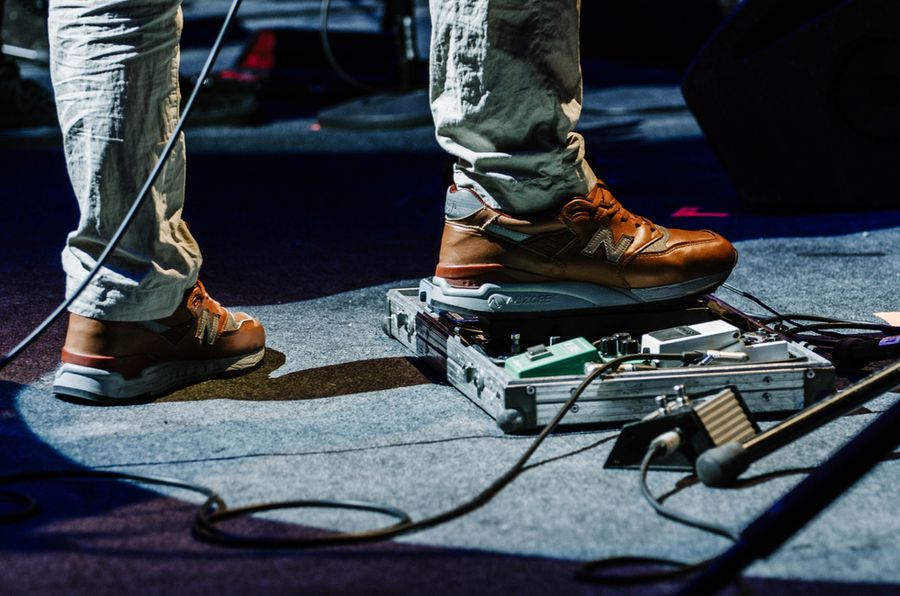
A loop pedal can turn one guitarist into an entire arrangement by recording a progression and stacking additional parts over it in real time. Simple pedals make it easy to build rhythm and lead layers, while more advanced models can separate song sections, store compositions, or synchronize with other equipment. The right choice depends on how complicated you want your arrangements to become. Several loopers offer distinct approaches to overdubbing, song structure, storage, and hands-free control.
Decide How Many Layers You Really Need
Nearly any looper can record a rhythm part and let you overdub additional guitar lines, but the workflow becomes more important as arrangements grow. A single-track pedal works well when every new part can sit on top of the same repeating section. Two-track designs provide greater flexibility when you want independent layers or separate sections.
Memory also matters if you want to preserve ideas instead of rebuilding every arrangement from scratch. Players who mainly improvise at home may be satisfied with one active loop, while songwriters and performers can benefit from multiple saved sessions.
Consider foot control as well. Recording, overdubbing, undoing mistakes, stopping loops, and switching sections all need to happen without taking your hands away from the guitar.
BOSS RC-500: Best for Building Two-Part Arrangements
The BOSS RC-500 provides two independent loop tracks, making it particularly useful for solo guitarists who want arrangements that extend beyond one repeating progression. The tracks can be used together for layered textures or independently for different portions of a song.
It provides approximately 13 hours of total stereo recording capacity across 99 phrase memories. Three onboard footswitches control core functions, and additional footswitches or an expression pedal can expand hands-free control. The pedal also includes stereo instrument inputs, an independent XLR microphone input with phantom power, 57 preset rhythms with two variations each, and several loop effects.
The microphone input makes the RC-500 particularly interesting for singer-guitarists who want to incorporate vocals or another mic-based sound source. Its two-track architecture can also make verse-and-chorus-style arrangements easier to manage than repeatedly stacking everything onto one loop.
There is considerably more to learn than with a one-button looper, but that complexity provides greater room for arrangements to develop.
TC Electronic Ditto+: Best for Simple Layering and Saving Ideas
The TC Electronic Ditto+ keeps the basic looping workflow relatively straightforward while adding substantial storage for players who do not want every session to disappear when they move on to another idea.
It provides 60 minutes of recording time and 99 loop-session slots. Unlimited overdubbing allows additional guitar parts to be stacked onto a loop, while undo and redo functions make it possible to remove or restore the most recent layer. Its Extended Loop Mode also allows a longer overdub to be recorded over a shorter original loop by repeating that underlying section as necessary.
That combination works well for songwriting. You might record a short chord progression first, add a bass-like guitar part, then build a melody or longer phrase across several repetitions without immediately moving to a multitrack workstation.
The Ditto+ is especially appealing when you want saved loops and flexible overdubbing without dedicating a large section of your pedalboard to looping controls.
Pigtronix Infinity 3: Best for Independent Loop Sections
The Pigtronix Infinity 3 is designed around two stereo loop pairs that can operate in several ways. The loops can play simultaneously for layered arrangements or in series, which provides a straightforward way to create contrasting sections such as a verse and chorus.
It offers approximately three hours of recording time across as many as 50 loop pairs. The two loops can be synchronized, configured so one runs for multiple repetitions of the other, or operated independently. MIDI support also allows the pedal to synchronize and communicate with compatible drum machines, effects, and other equipment.
This structure provides considerable creative freedom for solo performers. One loop can establish the rhythmic foundation while the second introduces a separate chord sequence or melodic section. Switching between series and parallel operation also changes whether those ideas appear sequentially or simultaneously.
The Infinity 3 makes the most sense for players willing to spend some time learning a more elaborate looping workflow in exchange for greater control over song structure.
MXR Clone Looper: Best for Compact Creative Experimentation
The MXR Clone Looper takes a more compact approach while still offering several tools for manipulating layered guitar parts. It can record unlimited overdubs with a standard maximum loop length of six minutes, giving solo players enough room to construct substantial repeating arrangements.
Its creative controls include reverse playback along with double- and half-speed settings. Changing to double speed reduces available recording time to three minutes, while half speed extends it to 12 minutes. The most recent overdub can also be undone, and external switches or an expression pedal can provide additional control over selected functions.
Those speed and reverse options make the pedal especially interesting for experimental arrangements. A simple chord or note pattern can become a different texture after its direction or playback speed changes, providing material for new layers without requiring another instrument.
Build the Arrangement One Part at a Time
A good loop does not need five layers immediately. Begin with the part that establishes the rhythm and harmony, then listen for what the arrangement actually lacks. A restrained bass-register line, percussive muted part, harmony, or melody often adds more than repeatedly overdubbing similar chords.
Leave room for your live playing as well. If every frequency and rhythmic space is already occupied by loops, the lead part you perform over them can struggle to stand out.
Practice operating the pedal just as deliberately as you practice the guitar parts. Clean starts and stops are essential when several layers depend on the timing of the first loop.
Turn One Guitar Into a Fuller Arrangement
The best loop pedal depends on how far you want to take the layering process. The BOSS RC-500 provides two tracks and extensive storage, the Ditto+ keeps looping approachable while preserving numerous sessions, the Infinity 3 offers flexible two-loop song construction, and the MXR Clone Looper adds creative speed and reverse controls in a compact format.
Start with a pedal whose workflow matches the arrangements you actually want to create. Once recording and overdubbing become instinctive, a looper can shift from being a practice accessory to an instrument in its own right, giving one guitarist the tools to build rhythm, harmony, texture, and melody from the ground up.