

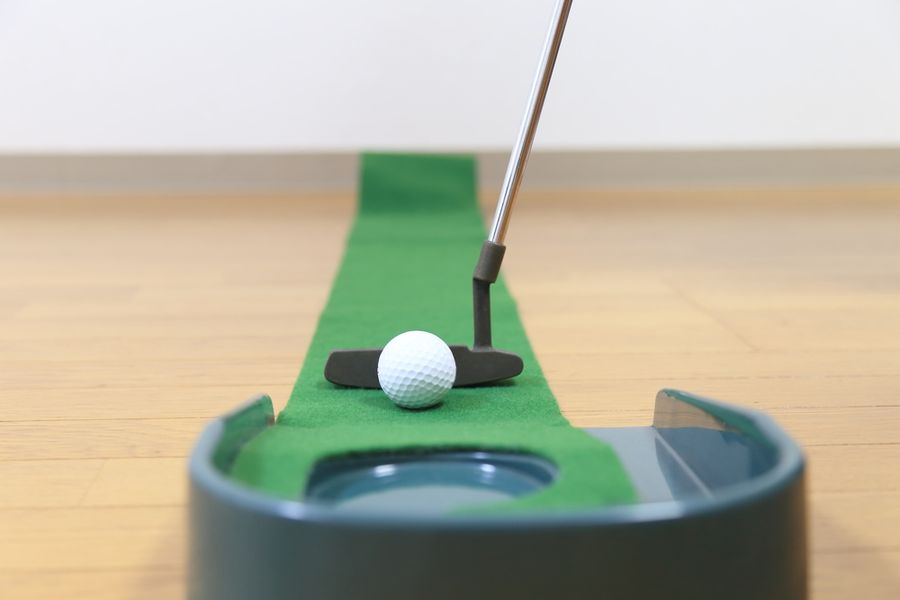
Improving your putting does not require a backyard green or an elaborate home golf simulator. A few feet of level floor, a putter, several golf balls, and a reliable target can provide enough space to work on the fundamentals that matter most. Indoor practice is particularly useful for developing a repeatable setup, starting the ball on your intended line, and controlling pace. By keeping the equipment simple, you can devote more attention to the quality of each stroke.
Create a Consistent Practice Area
Start by finding the flattest section of floor available. A dedicated putting mat provides a predictable surface, but a smooth, low-pile carpet can also work for basic stroke and alignment practice. You will also need a target. A putting cup is convenient, but a small object or marked spot can work when the objective is simply rolling the ball along a chosen line.
Keep the area uncluttered enough to make a natural stroke without hitting furniture. If possible, leave the setup assembled for several days. Removing the need to roll out equipment before every session makes short practice periods easier to fit into your routine.
Use the same putter you normally take to the course. Indoor practice becomes more useful when your grip, stance, and equipment remain familiar rather than changing from session to session.
Build a Gate to Test Your Starting Line
One of the simplest indoor drills is creating a narrow gate that the ball must pass through after impact. The PGA of America recommends an at-home drill using parallel alignment sticks along with another gate positioned around the putter head. The golfer begins from about four feet and can gradually increase the distance while trying to send consecutive putts through the gate.
You can simplify the idea with household objects. Place two coins, small blocks, or similar markers slightly wider than the golf ball several inches in front of it. Aim through the opening and make a normal stroke. If the ball clips either marker, you immediately know that it did not begin on the intended line.
Do not make the gate extremely narrow at first. Begin with enough room to succeed consistently, then gradually reduce the opening as your control improves.
Practice Short Putts With a Repeatable Stroke
Short putts are particularly well suited to indoor practice because they require little floor space. Rather than repeatedly hitting balls without a goal, choose one distance and try to establish a repeatable routine.
Titleist provides an indoor short-putting drill that uses household furniture and an alignment rod to help golfers work on putter movement and maintaining a steady stance. The exact equipment is less important than the principle: create a reference that reveals whether your stroke is repeating consistently.
Try hitting sets of five balls from the same spot. Reset your stance before each one instead of remaining planted and rapidly pulling another ball into position. This turns every attempt into its own putt and encourages you to practice the routine as well as the stroke.
Add Distance Control Without a Regulation Hole
Indoor putting should not focus exclusively on making short putts. You can practice pace even when your room is too small for long lag putts.
Place several targets at increasing distances and try to stop the ball beside each one rather than simply hitting toward the far end of the mat. Titleist uses a speed-control drill in which golfers roll putts toward progressively farther reference points, emphasizing consistent control of how far the ball travels.
Another option is to create a stopping zone with two pieces of painter's tape. Try to roll each ball beyond the first line without crossing the second. Once you can repeatedly finish inside the zone, move it farther away.
Changing the target forces you to vary stroke length and pace instead of memorizing one movement. That makes the exercise more demanding than repeatedly hitting identical putts from the same distance.
Make Practice Measurable
A simple scoring system can keep indoor sessions focused. Give yourself one point for every ball that passes through your starting-line gate, lands inside your distance-control zone, or reaches the chosen target. Record the result and try to improve it during the next session.
You can also alternate among distances rather than repeating the same putt indefinitely. A PGA of America home drill uses targets at three, five, and seven feet and requires successful putts before progressing through the sequence.
Keep sessions relatively focused instead of continuing until concentration disappears. Ten deliberate putts with a clear objective can tell you more about your stroke than dozens hit without resetting or evaluating the outcome.
Give Longer Putts Some Attention
A home setup cannot perfectly reproduce the slopes, grain, moisture, and speed changes found on an actual green. However, it can still reinforce the idea that longer putting is largely about leaving the ball a manageable distance from the target rather than treating every attempt as a must-make putt.
Distance and speed control are central parts of effective lag putting, and practicing the ability to finish near a target can help build that skill. Set a generous finishing zone at the far end of your available practice area and gradually shrink it as your control improves.
Turn a Small Space Into Useful Practice
A productive indoor putting area does not have to be complicated. A flat surface, a few balls, a target, and several inexpensive household markers provide enough feedback to work on starting direction, stroke consistency, and pace.
The key is giving every putt a purpose. Build a gate, change distances, keep score, and reset before each attempt instead of simply rolling balls across the floor. Regular practice with a simple setup can make your putting motion more familiar and give you clearer feedback about where your misses begin before you return to the course.