
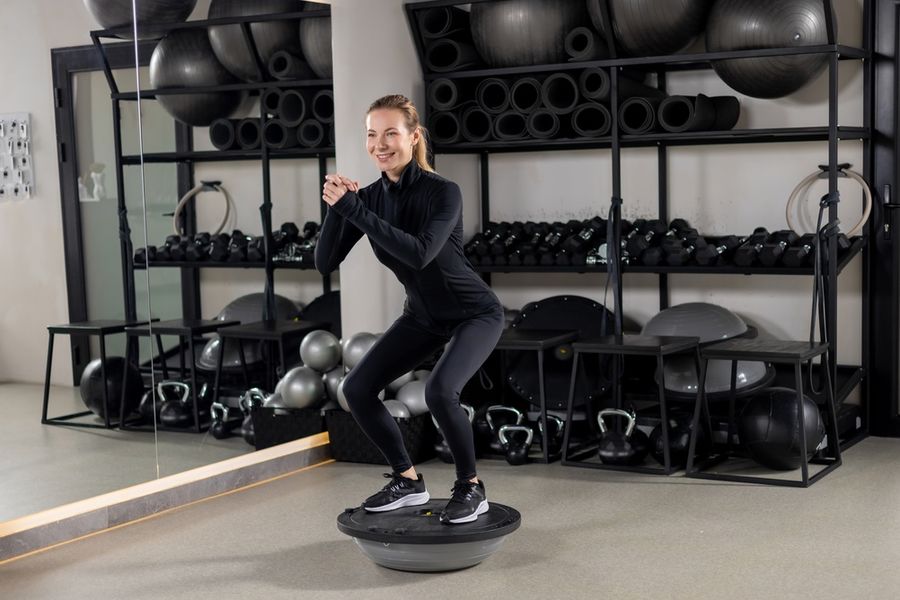
Balance boards can make an ordinary home workout more challenging by forcing you to continually adjust your position on an unstable surface. They can be incorporated into standing drills, squats, core exercises, and sport-specific practice without requiring a large home gym. However, designs vary considerably: some rock in one direction, others wobble through 360 degrees, and roller boards demand quicker reactions. Several options suit different experience levels and approaches to at-home stability training.
1) Revbalance 101 v2: Adjustable Challenge for Progression
The Revbalance 101 v2 is a roller-style board that makes sense for users who want room to progress rather than a fixed level of difficulty. Its board moves over a cylindrical roller, requiring frequent adjustments as your weight shifts from side to side.
A particularly useful feature for beginners is the adjustable Magswitch stop system. The distance between the stops can be shortened to reduce the board’s travel, then increased as control improves. The stops can also be removed completely for unrestricted movement. Revbalance uses a nonabrasive Durasoft grip surface designed for use with or without shoes and includes a digital guide with exercises and introductory material.
That adjustability makes the 101 v2 particularly suitable for someone who wants to start cautiously but does not want to outgrow the board quickly. Because a roller design can move faster than a basic rocker board, beginners should initially practice near a sturdy counter, wall, or other stable support.
2) Indo Board Original: A Classic Roller-Board Setup
The Indo Board Original takes a similar roller-based approach but offers several bases that change how the board behaves. Its flat maple deck measures 30 by 18 inches, has a textured nonslip surface, and includes stops underneath that help keep the roller beneath the deck. The board has a listed 350-pound weight limit.
Its biggest advantage is the choice of base. The standard Original Roller creates faster movement, while the Foam Roller provides a slower, more forgiving option. Indo also offers a Flow Cushion that creates instability in multiple directions rather than primarily side-to-side movement.
This makes the Original useful for households where more than one person may train at different levels. A newcomer can begin with the slower base, while someone accustomed to board sports may prefer the more responsive roller. Switching bases also changes the character of the exercise without requiring an entirely different deck.
3) Yes4All Wobble Balance Board: Compact 360-Degree Movement
A roller is not necessary if you simply want to add instability to common home exercises. The Yes4All Wooden Wobble Balance Board uses a central base that allows the platform to tilt and move in multiple directions.
The board measures 15.75 inches across and provides 360-degree rotation with a 15-degree tilt angle. Its wooden platform supports up to 300 pounds and incorporates an anti-skid surface for additional grip. The multidirectional design accommodates front-to-back, side-to-side, and circular movements, while the compact platform makes it relatively easy to store between workouts.
The wobble board can also be incorporated into exercises such as squats, planks, and pushups rather than being limited to standing drills. Compared with a loose roller design, the movement remains centered beneath the platform, providing a different style of stability challenge.
4) StrongTek Advanced Balance Board: A Wooden Wobble Alternative
The StrongTek Advanced Balance Board provides another option for people who prefer a wooden platform but want multidirectional wobble rather than a separate roller. Its design combines a wooden board with a cross-style base that permits 360-degree movement, and the standing surface incorporates nonslip material.
That arrangement makes it suited to controlled weight shifting without requiring the user to keep a loose roller beneath the board. You can begin with simple two-footed standing and gentle shifts before adding movement such as shallow squats or upper-body exercises.
A wooden platform can also feel more substantial underfoot than a small plastic disc. The better choice comes down to how much floor space you have and whether you prefer a broad standing surface or maximum portability.
Choose a Board That Matches Your Starting Point
The most challenging board is not necessarily the most useful one. A beginner who spends every session gripping nearby furniture may get more productive practice from a predictable rocker or wobble design. Roller boards generally demand faster corrections and may make more sense after basic control has developed.
Think about the exercises you plan to perform as well. Multidirectional wobble boards work naturally with stationary strength movements, while roller boards can provide a more board-sport-like experience. Surface grip, platform size, available floor space, and storage requirements are also worth considering.
Whichever design you choose, begin with uncomplicated movements. Stand with both feet comfortably positioned and practice small weight shifts before progressing to deeper squats, single-leg work, weights, or other added challenges. Use the board on a suitable stable surface and keep a solid support within reach while becoming familiar with its movement.
Build Stability Training Gradually
A balance board does not need to turn every workout into an advanced balancing act. Its value at home comes from adding manageable instability to exercises you can perform consistently and safely. Revbalance and Indo Board provide progressively challenging roller experiences, while the Yes4All and StrongTek designs offer compact multidirectional movement without a loose roller.
Choose according to your current ability rather than the most impressive-looking exercise you hope to perform later. Once basic standing and weight shifts feel controlled, gradually introduce more complex movements. A board that provides enough challenge to demand attention without making every exercise unmanageable can become a practical addition to regular home stability training.