

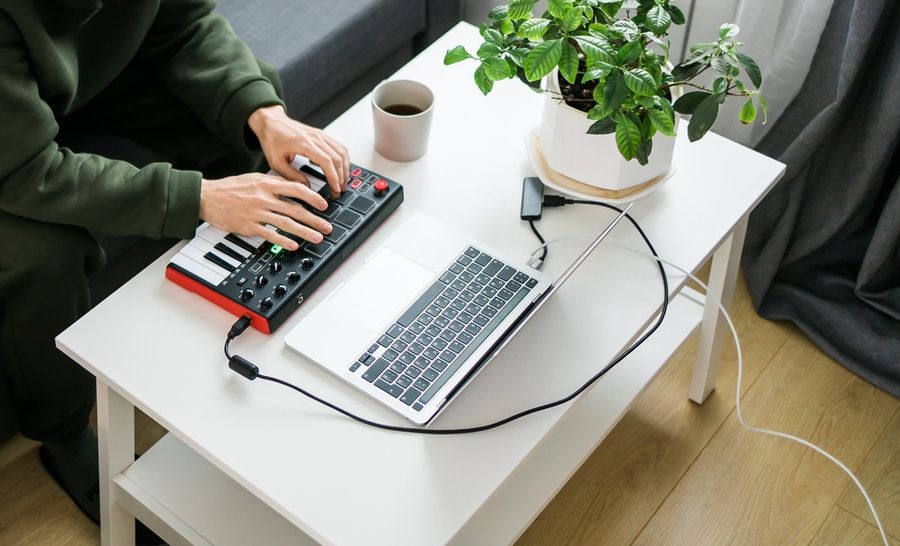
Music production no longer has to stay tied to a permanent studio desk. A compact MIDI controller can turn a laptop into a more tactile songwriting setup, giving you physical keys, pads, knobs, and transport controls without taking up much room in a bag. Some models prioritize beat making, while others provide more keys or tighter software integration. The best portable controllers offer different ways to sketch melodies, program drums, shape sounds, and control sessions wherever you happen to be working.
Decide Which Controls You Need Away From Home
Portability involves more than choosing the smallest keyboard available. A 25-key controller saves space, but a 32- or 37-key model gives melodies and chord progressions more room before you need to use octave buttons. Producers who primarily program drums may care more about responsive pads than the number of keys.
Think about the other controls you regularly reach for as well. Physical knobs can make synth and effect adjustments easier, while transport buttons reduce how often you need to return to a laptop trackpad. A conventional MIDI output can also be valuable if you plan to connect portable hardware synthesizers rather than work exclusively inside a computer.
USB bus power is particularly useful for a travel setup because the controller can draw power directly from a compatible computer instead of requiring another wall adapter.
Akai MPK Mini IV: A Compact All-Rounder for Beat Makers
The Akai MPK Mini IV packs a broad selection of controls into a controller that measures 13.68 inches wide and weighs 2.31 pounds. It has 25 velocity-sensitive mini keys, eight velocity- and pressure-sensitive RGB MPC pads, eight assignable rotary knobs, dedicated pitch and modulation wheels, and a full-color screen.
The combination is particularly useful for producers who move frequently between keyboard parts and finger drumming. The pads can handle drum programming and sample triggering, while the knobs provide hands-on control for instruments and effects.
USB-C handles both computer connectivity and bus power. A full-size five-pin MIDI output also allows the MPK Mini IV to control compatible hardware without relying exclusively on USB. Scale and Chord modes can simplify melodic experimentation, while the built-in arpeggiator provides another way to generate patterns from a compact keyboard.
For a producer who wants one small controller to handle keys, beats, and hardware connections, the MPK Mini IV offers an unusually broad toolset without requiring much desk space.
Arturia MiniLab 3: Flexible Control in a Small Studio Setup
The Arturia MiniLab 3 combines 25 velocity-sensitive slim keys with 16 pad assignments across two banks, eight rotary encoders, four sliders, and touch-sensitive pitch and modulation controls. The unit measures about 14 by 8.7 by 2 inches and weighs approximately 3.3 pounds.
Four sliders distinguish it from many compact controllers that rely mostly on rotary knobs. Those controls can be useful for adjusting mixer levels, instrument parameters, or other software functions without constantly moving between the controller and computer.
A small display and clickable browsing knob provide additional feedback while selecting and adjusting parameters. The controller connects over USB-C and can also communicate with compatible external equipment through a five-pin MIDI output. It is USB powered, keeping the mobile setup relatively straightforward.
Built-in Chord and arpeggiator functions provide quick starting points when writing, while integration with major DAWs makes the MiniLab 3 particularly suitable for producers who want a small controller that can handle both playing and session control.
Novation Launchkey Mini 37 MK4: More Keys Without Going Full Size
The Launchkey Mini 37 MK4 provides three octaves of mini keys, making it appealing to players who find 25-key controllers restrictive but still need something designed for portable production. Its 37 velocity-sensitive keys are joined by 16 velocity-sensitive pads and eight endless rotary encoders.
The extra octave can make a meaningful difference when working on two-handed chord voicings, bass-and-melody ideas, or parts that span a wider register. You will still have octave controls available, but fewer shifts may be necessary while performing.
The 16 pads provide more immediate access to drum sounds or clips than an eight-pad layout. They can also trigger chords or individual notes and support polyphonic aftertouch. Scale and Chord modes offer additional options for composing, while a generative arpeggiator can turn held notes into evolving patterns.
Its deeper DAW controls are particularly useful when a portable setup needs to function as more than a note-entry keyboard. Mixer, plugin, send, transport, and other functions can be managed from the controller, reducing dependence on the mouse during a mobile session.
Native Instruments Komplete Kontrol M32: More Room for Melodic Ideas
The Komplete Kontrol M32 takes another middle-ground approach with 32 compact keys. It includes eight touch-sensitive control knobs, an OLED display, two touch strips for expression, and dedicated buttons for common production functions. USB bus power means a laptop can provide the power needed for a basic mobile setup.
The additional keys make the M32 useful for producers who compose primarily with keyboard-based instruments but still want something considerably smaller than a full-size controller. Chord and arpeggio functions can generate more complex parts from simple input, while scale features can map selected scales across the keyboard.
Its strongest appeal is software-focused control. Browsing sounds and adjusting compatible instruments can be handled from the hardware, reducing the amount of screen navigation needed when working from a laptop in a confined space.
Unlike controllers centered heavily on drum pads, the M32 is better suited to someone whose portable workflow revolves around synths, keys, chords, and melodic composition.
Build a Travel Setup Around How You Produce
The right portable MIDI controller should make your normal workflow easier rather than forcing you to change it. The MPK Mini IV provides a balanced combination of pads, keys, knobs, and hardware connectivity. MiniLab 3 adds sliders and extensive hands-on controls, while Launchkey Mini 37 offers more keyboard range and 16 performance pads. Komplete Kontrol M32 favors melodic production and integrated software control.
Also consider what else must fit in the bag. A laptop, headphones, audio interface, cables, and external drive can quickly turn a supposedly portable studio into a heavy collection of equipment. A controller that handles several jobs may allow other devices to stay home.
Capture Ideas Wherever They Appear
A portable controller is most useful when it removes obstacles between an idea and a recorded sketch. You do not need every studio control on the road; you need enough keys, pads, and hands-on functions to capture the parts that matter before inspiration disappears.
Choose a model around the way you actually create. Beat-focused producers may prioritize pads, keyboard players may prefer additional keys, and hardware users may need conventional MIDI connectivity. When the controller matches your workflow, a laptop and a small amount of gear can become a capable production space almost anywhere.