

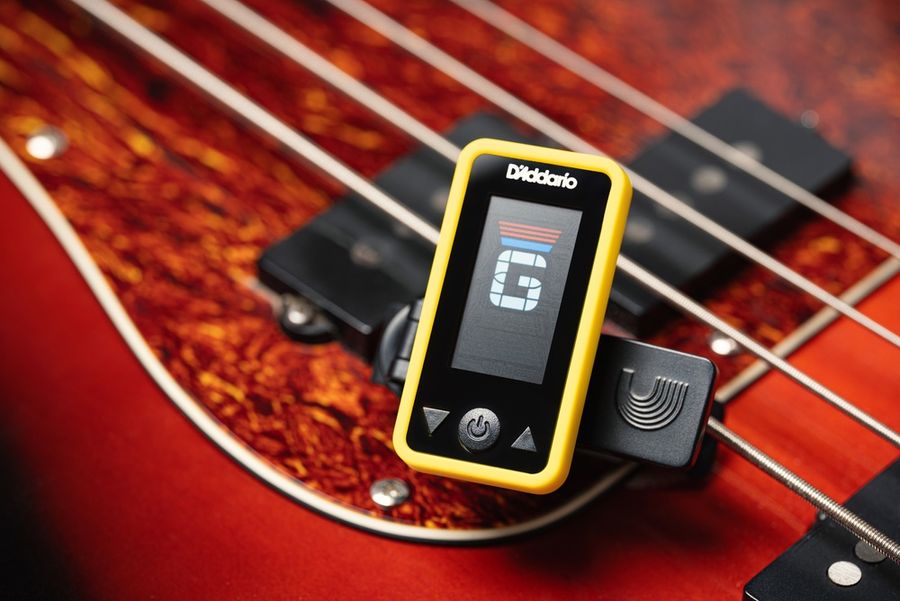
A clip-on tuner can eliminate much of the setup involved in checking an instrument’s pitch. Instead of plugging into a pedal or relying on a phone microphone, compact devices attach directly to the instrument and detect its vibrations. That makes them useful for quick adjustments during practice, rehearsals, and performances. Different models emphasize precision, display visibility, multi-string tuning, or compact design, so the best option depends on both the instrument you play and how much control you need.
1) Peterson StroboClip HDC-V: Best for High-Precision Tuning
The Peterson StroboClip HDC-V is aimed at musicians who want more precision than a basic needle-style tuner provides. Its strobe tuning system offers accuracy to 0.1 cent, while a high-definition color-backlit display makes small pitch differences easier to identify.
The tuner includes more than 65 Sweetened Tuning presets covering various instruments and tuning approaches. These presets make it suitable for more than standard six-string guitar tuning, with options extending to basses and other stringed instruments.
A rechargeable lithium-ion battery removes the need to keep spare coin cells in a gig bag. It provides up to six hours of tuning time per charge and recharges through USB-C.
This model makes the most sense for players who regularly perform setups, experiment with alternate tunings, or simply prefer a highly sensitive tuning display. The additional options may be unnecessary for someone who only wants to check standard guitar tuning quickly before practice.
2) Korg Pitchclip 2+: Best for a Clear, Detailed Display
The Korg Pitchclip 2+ combines a compact headstock design with a 17-LED meter designed to make small pitch differences easier to see. Three display modes are available: Regular, Strobe, and Half Strobe. The two strobe modes provide tuning accuracy of ±0.1 cent.
Its display can also be reversed vertically. That allows the tuner to remain readable when attached behind the headstock or positioned for a left-handed player.
The clip is covered with rubber to improve grip while protecting the area where it contacts the instrument. At less than 20 grams with the battery installed, it also adds very little weight to the headstock.
Pitchclip 2+ works with instruments ranging from guitar and bass to other electric and acoustic instruments. Its combination of simple controls and higher-precision display modes makes it particularly useful when you want quick everyday tuning without giving up the option for more careful adjustments.
3) TC Electronic PolyTune Clip: Best for Checking Several Strings Quickly
The TC Electronic PolyTune Clip offers an unusual shortcut for guitarists: its polyphonic mode can evaluate all six strings from a single strum. Instead of checking each string individually, you can quickly see which ones require attention and then tune those strings more precisely.
The tuner also provides conventional chromatic and strobe modes. Chromatic mode is useful for normal one-note-at-a-time tuning, while strobe mode provides accuracy of ±0.02 cent when greater precision is needed.
A 108-LED display automatically adjusts its orientation depending on how the tuner is positioned. That flexibility makes it easier to mount on different sides of the headstock without having to read an inverted display.
The PolyTune Clip is particularly convenient for players moving between songs or checking tuning during a rehearsal. A quick strum can identify the problem strings before you spend time making individual corrections.
4) D'Addario Eclipse Tuner: Best for Straightforward Everyday Use
The D'Addario Eclipse keeps the feature set comparatively simple. It is a chromatic headstock tuner with a full-color vertical display, automatic power-off, and calibration adjustable from 430 to 450 Hz.
Its multi-swivel mounting design lets you change the viewing angle and attach the tuner either in front of or behind the headstock. It can also accommodate both right- and left-handed instrument setups.
That simplicity can be an advantage when you do not need alternate tuning systems, multiple display modes, or extensive configuration menus. Attach it, play a note, make the adjustment, and move on.
The Eclipse is designed for guitar and bass and works equally well as a tuner kept on a practice instrument, stored in a case, or carried as a backup. For musicians who mainly want a clear display and fast chromatic tuning, additional features may simply get in the way.
5) Fender Bullet Tuner: Best for a Low-Profile Setup
The Fender Bullet Tuner takes compactness further with an aluminum housing measuring approximately 36.6 by 14 by 38.8 millimeters and weighing 13.5 grams. Its vibration-based system provides chromatic tuning with stated accuracy of ±1 cent.
A color LED screen displays tuning information, while a 10-minute automatic sleep mode helps conserve the two included LR44 batteries. Its tuning range extends from A at 27.5 Hz through C at 4186 Hz.
The small design makes it especially appealing to players who dislike leaving a larger screen perched above the headstock. It can remain relatively unobtrusive while still providing an easily accessible tuning reference for guitar or bass.
Its precision specification is less demanding than the strobe modes offered by several other models here, but extreme accuracy is not necessary for every practice session or quick onstage correction.
Choose the Tuner That Fits Your Routine
A clip-on tuner should make tuning quicker rather than adding another complicated device to manage. The Peterson StroboClip HDC-V emphasizes precision and specialized tuning options, while the Korg Pitchclip 2+ combines a detailed display with several meter modes. The PolyTune Clip speeds up six-string checks, the D'Addario Eclipse keeps everyday operation simple, and Fender's Bullet Tuner favors a small, discreet footprint.
Think about how often you change tunings, how much accuracy you actually need, and where you expect to use the tuner. A model that stays attached, remains easy to read, and gives you the information you need quickly is more useful than one packed with features you rarely touch.