

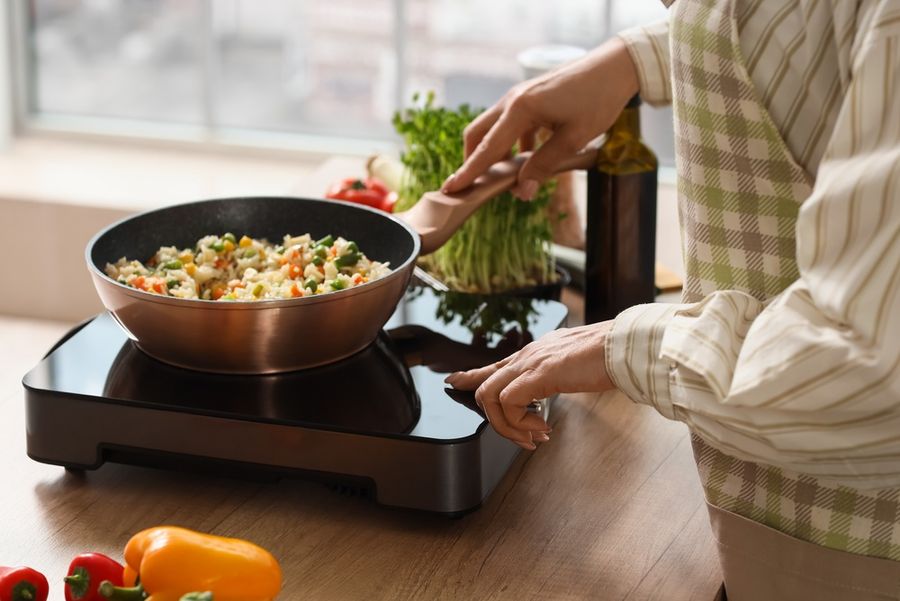
A small kitchen can become crowded quickly when several dishes need attention at once. A portable induction cooktop adds another cooking zone without requiring a permanent range, built-in burner, or major renovation. Compact appliances can sit on a counter when needed and move into storage afterward, making them useful for apartments, galley kitchens, and busy meal-prep days. By evaluating available counter space, compatible cookware, and how much temperature control you expect from the extra burner, you can achieve the right set-up.
Understand How Induction Creates an Extra Cooking Zone
Unlike a conventional electric burner that heats an element first, induction creates heat directly within compatible cookware through an electromagnetic field. Removing the pan stops that heating process, although the glass surface can remain warm from contact with the hot cookware. Induction also requires pots and pans with magnetic material in the base; a simple magnet test can help determine whether existing cookware is compatible.
That combination works particularly well when the purpose is adding temporary cooking capacity. A portable unit can handle a saucepan, skillet, or stockpot while the main stove is occupied with other dishes. Once cooking is finished and the appliance has cooled, the countertop can return to food preparation or another use instead of permanently giving up space to another burner.
Make Counter Space Part of the Buying Decision
Portable does not necessarily mean tiny, so measure the section of counter where the cooktop will actually operate. Leave enough surrounding room to position cookware comfortably and follow the clearance instructions supplied with the particular model. A unit that fits neatly into a cabinet may still be inconvenient if it consumes the only usable food-preparation area while running.
The IKEA TILLREDA illustrates how compact a single induction zone can be. It measures 10 5/8 inches wide, 12 3/4 inches deep, and 2 1/2 inches high and weighs 6 pounds. The 120-volt unit provides one 1,800-watt induction zone and is specifically designed to be moved and stored when it is not needed. Those dimensions make it easier to envision whether an extra burner can coexist with a cutting board, dish rack, or other countertop essentials.
Choose Controls Around the Food You Cook
Not every extra burner needs elaborate temperature programming. If the cooktop will mainly boil pasta water, heat soup, sauté vegetables, or keep a side dish cooking while the range is occupied, straightforward power controls may be easier to manage than a large collection of specialized modes.
The Hamilton Beach 34104 Portable Induction Cooker provides 1,800 watts and 10 heat settings, with the option to cook by temperature or by power level. Its footprint is 11.73 inches wide by 13.88 inches deep, with a height of 2.68 inches. That combination suits a small kitchen where the appliance may need to move between a countertop during dinner preparation and a cabinet or pantry shelf afterward.
Consider More Precise Temperature Adjustment
Some cooks use a portable burner for tasks where greater temperature control is valuable. Melting chocolate, maintaining a gentle sauce, simmering, or moving between low and high heat can benefit from smaller adjustment increments rather than a handful of broad power levels.
The Nuwave PIC Flex Pro provides 45 temperature settings in 5-degree increments across a range from 100°F to 500°F. It measures 11.75 by 10.25 by 2.25 inches, weighs 4.11 pounds, and operates at up to 1,400 watts. Its built-in features include automatic shutoff, cookware detection, and a child safety lock. Those controls make it an option for cooks who want the extra burner to handle more than simple boiling or reheating.
Check Your Cookware Before Clearing the Counter
Buying a portable induction burner is less useful if none of your favorite pans will work with it. Cast iron and many stainless-steel or enameled iron pans are induction compatible, but cookware construction varies. Flat-bottom cookware that attracts a magnet is a practical indicator of compatibility.
Test the pans you expect to use before choosing the cooktop. Also consider their diameter in relation to the cooking zone specified by the manufacturer. A small portable burner can be convenient for saucepans and skillets, but an oversized pot may not perform as well on a compact induction zone. Matching the appliance to the cookware you already reach for can prevent the extra cooking space from requiring an entirely new collection of pans.
Give the Portable Burner a Safe Working Area
A portable cooktop should be treated as active cooking equipment rather than another small appliance squeezed wherever an outlet happens to be available. Place it on a flat, stable surface with enough room for the pan and its handles. Keep the working area clear of loose towels, packaging, papers, and other objects that do not belong beside hot cookware.
Plan the electrical connection as carefully as the countertop position. Follow the manufacturer's power and outlet instructions rather than assuming every extension cord, power strip, or crowded kitchen circuit is appropriate for a high-wattage cooking appliance. Keep the power cord away from hot surfaces and arrange the unit so you are not reaching across it to use the sink or retrieve ingredients.
Store It Where You Will Actually Use It
The biggest advantage of a portable induction cooktop in a small kitchen disappears if retrieving it becomes a project. A slim pantry shelf, deep drawer, lower cabinet, or other accessible location can keep the unit close enough for regular use without occupying permanent counter space.
Store the cooktop only after it has cooled and been cleaned according to its instructions. Keeping the surface free of dried spills also means the appliance is ready when you need an additional burner unexpectedly. If you use it regularly, store compatible cookware nearby so setting up the extra cooking zone takes only a few moments.
Expand the Kitchen Without Remodeling It
A portable induction cooktop can solve a very specific small-kitchen problem: not having enough active cooking space when several dishes need to come together at once. Instead of replacing the range or sacrificing countertop space permanently, you can add one cooking zone when the meal requires it and put that zone away afterward.
Choose the unit around the space you have, the cookware you already own, and the amount of control your cooking needs. Whether the priority is compact storage, simple high-powered heating, or more precise temperature adjustment, the right portable induction cooktop can give a small kitchen additional flexibility without making the room feel more crowded.